
I am with Americo
At one time, the brigands resisted the Piedmontese with assaults, ambushes, conflicts that exposed them to the risk of visibility; today, what remains of that resistance is a tenacious force, often invisible to the eyes of most, experienced in an integral manner by those who were born here and have lived here for a lifetime.
The invisible resistance
Amerigo, so it seems to me, then I discover it is Americo, whatever the final syllable, this name reminds me of Amerigo Vespucci, his exploits as a great explorer across the ocean, the name America of the continent with which our culture often has a love-hate relationship.
Our Americo does not explore new lands, but has been frequenting the same ones since he was 12 years old and used to climb these mountains to learn the shepherd's trade. The Duchessa's mountains, like many others in Italy and Europe, are places of Elsewhere to get to whose summits one crosses an invisible border between the land of men and the land of the gods. The ancients throughout the world placed their deities on top of mountains that they made sacred, therefore, inaccessible to men and separated from the human world. When we, too, enter this dimension, we remember our ancestors and their clear separation that always involved an ascent to the gods, a descent to men.
Americo's world is this: close in terms of kilometres to villages and small towns, distant in terms of life experience, surrounded by peaks, trees, clouds, sky, rocks, all of staggering beauty.
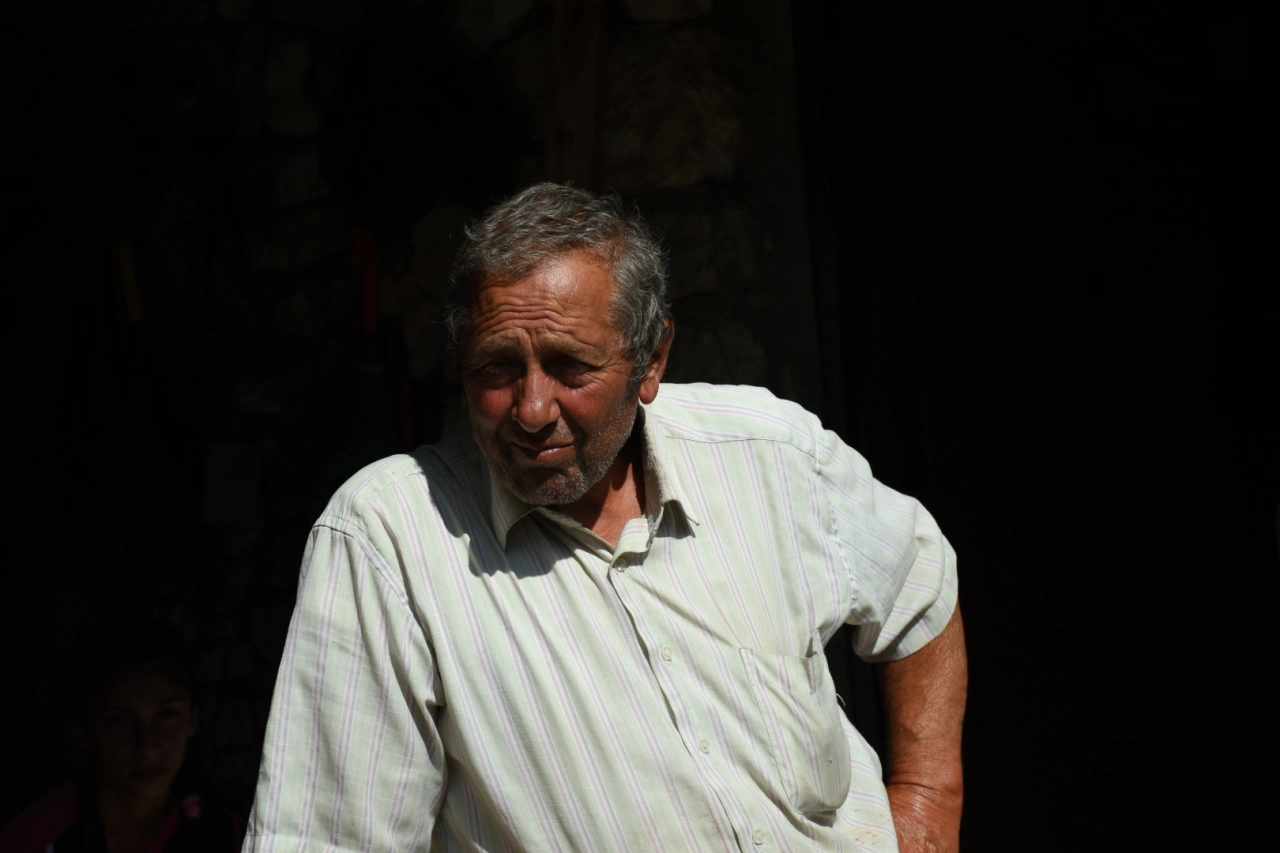
Shepherd, that's his surname, the real one has been absorbed by his profession that has always shaped the body and spirit of this man. At the moment, he shepherds 400 sheep that he lets loose around the lake during the day and retreats to the pen at night. His best colleagues are the dogs, great helpers of human work, a bit of a link between our world and that of animals. Respected by the local wild beasts, they have never been harmed by the wolves that pass through here and stay the night. Threatened, however, and killed by humans who poisoned eight of them this year, on the very day Americo moved from the valley floor to the malga. Killed by human hands, amidst a thousand sufferings, buried in this mountain land by their master who in the same land declares he wants to be buried. He has tears in his eyes when he speaks of his dogs: intelligent, obedient, respectful of lambs and sheep. Characteristics, these, that are now rare in humans, non-existent in those who poisoned them to threaten their master. Their death was used as a code language to wear down and weaken Americo's resistance up here. Who here does not face the severity of nature, its strict and ancestral laws that he carries stamped in his heart and tries to pass on to his grandson Victorian. He bravely resists quite another harshness: that of man who spreads his dishonesty, his thievery, his dirty tricks of power up here in a land that does not belong to him, but which he wants to bend to his unhealthy and destructive thirst for power.
Homo homini lupus
It is this race of wolves that Americo fights by staying in his place, paying taxes, declaring the number of grazing beasts to the municipality, not yielding to abuse. Others, on the other hand, do not care that their beasts sully the lake water with their humours, make it a muddy swamp destined to disappear. The reasoning horizons of these men are myopic, bounded by contingent and trivial interests. Americo's interests reach beyond his generation, sewing the heritage of the generation that preceded him with the one that will follow. So that his grandchildren too can enjoy this beauty, complete, fulfilling the eyes, the mind, the heart, the spirit that never leaves alone those who pass even for a few hours in this place. The solitude of the mountains offers fullness unlike that of the city, which plunders, strips away body and soul without modesty.
Americo urges us to enter his enclosure and, despite the cow skulls hanging on the gate that might seem repulsive, the shepherd is of rare hospitality. First he makes coffee, then he invites us to lunch for pasta and ricotta, impossible to refuse. To enter his enclosure is to be a guest not only of his space, but also of his story of daily heroism in solitude. He tells of his work with candour, without blunders; the injustices he fights against narrated here among the peaks arouse more indignation than if they were narrated in the city, and yet they have the same ingredients of envy, profit, greed. But if they are presented in the city, we are less and less inclined to be indignant and more and more inclined to find a grey area of compromise, here healthy indignation still has the courage to spring forth. Perhaps it has its natural source in the illusion that the peaks can still be intact places, preserved from human encroachment. Our words of astonishment and regret mark the fall of a dream, of a desire, of a hope, we are faced with the misery of mankind that infects what it touches. Resisting is Americo's watchword, resisting the de-humanity that has already claimed many victims and is now snaking as a possible shortcut in the souls of us all.
Let us organise in our souls a network of resistance that crosses all geographical, anagraphic and historical boundaries and remain vigilant on the profound value of humanity. We greet each other with an embrace that prints the imprint of his body, almost a mark, in the body of each of us, a warning footprint on our path of mutual vigilance. A hidden tear escapes, a sign that something in the heart still knows how to stir and animate itself with new life.
Costanza, Antonietta, Lucia di Rosciolo also resist. They make the encounter their personal, and dare I say, feminine, art of resisting time, which, like a river, washes away the stories, experiences and vicissitudes of this village. A little wall, a few chairs on the street and the lounge for chatting is set up, around the summit of the Velino crowned by clouds, fresh, crisp air, scents of the fields. The words come out lightly, leaping from one person to another, never does the heaviness of nostalgia make them heavy, the unexpectedness of this meeting makes even the most painful contents tinged with light breath, something that rarely happens when chatting at home, the words bounce off the walls and fall back in front of us. The small community of chattering grows, and we are joined by an increasing number of cats, who are also engaged in effusive companionship.
The word of Antoinette, Lucia, joined by her cousin Maria becomes song in the evening, in front of the village bar under the surprised gaze of the young people who wonder what happened to these women. Singing, like dancing, touches the essence of mankind, crosses barriers of time and geography and works for the inclusion - a fashionable word of which few know the true meaning - of Italians with Italians. Dressed to the nines, made up, these ladies feel honoured by the impromptu audience of 14 walkers, they invite their cousin Maria, who also brings a booklet of songs, at first hidden in her bag, then taken out to choose from the index the text to be sung. Songs long hushed take the path of the voice that comes out loud and lively, the memory plays on and off, always saved by the written texts in the booklet. The opener is with a local song entitled 'Le ragazze di Rosciolo' (The girls of Rosciolo), which for us then becomes the background of hours of walking over the following days. This is followed by mountain songs, songs related to Piedmont, Florence, the Alpini, a repertoire that goes up and down the spine of Italy. We all discover that we belong a little to each song, regardless of our path in life. The lyrics contain pieces of the puzzle of our Italian character, so complex and elusive, if left to politicians' speeches, so essential and sharp, if entrusted to these encounters.
Words of spirituality proposes, instead, Costanza. 90 years, many of which she has spent being the perpetual of this country, committed to accompanying entire generations to the sacraments that mark stages in the formation of every young person. Her religiosity goes beyond belonging to a religion and becomes a communication of spirituality, another primary human need that city life often tends to sweep away, but which the life of nature restores. A need that resurfaces in the walk, along the line of steps that we carefully trace, the same ones that these old men take every day up and down the village under the gaze of the Velino, which makes not only their eyes but also their souls ascend to the heights.
They all make the same recommendation: 'Talk about our country! Send people!" Writing about them helps to honour the encounter, to perceive it even more as a great privilege to be treasured and cherished on life's journey.
"Let's go, let's go!" is how our guide shows us the way when we are at a crossroads and await his directions. The wish is that each one says the same phrase to himself when he resumes, back home, his path of always that is no longer the same as the one he left behind, to be nourished and nourished with the new steps of the journey.
(Lucia Giroletti, July 2019)
Sign the petition I am with Americo and with Duchess Lake.